Fedel Machado-Rivas, MD, Ellen Leitman, MD, PhD, Camilo Jaimes, MD, John Conklin, MD, Paul A. Caruso, MD, Chang A. Liu, MD and Michael S. Gee, MD, PhD. Predictors of Anesthetic Exposure in Pediatric MRI. American Journal of Roentgenology. doi. 10.2214/AJR.20.23601
ABSTRACT : Background: Anesthetic exposure in children may impact long-term neurocognitive outcomes. There is an interest to minimize pediatric MRI scan time under anesthesia and its associated anesthetic exposure.
Objective: To evaluate pediatric MRI scan time as a predictor of total propofol dose, considering imaging and clinical characteristics as covariates.
Materials and Methods: The EHR was retrospectively searched to identify MRI examinations performed under propofol anesthesia from 2016 to 2019 in patients 0-18 years old. Brain, brain and spine, brain and abdomen, and brain, head, and neck MRI examinations were included. Demographic, clinical, and imaging data were extracted for each examination, including anesthesia maintenance phase time, MRI scan time, and normalized propofol dose. MRI scan time and propofol dose were compared between groups using Student’s T-test. A multiple linear regression with backward selection (threshold P <0.05) was used to evaluate MRI scan time as predictor of total propofol dose, adjusting for sex, age, date of scan, body part, ASA classification, diagnosis, magnet strength, and IV contrast administration as covariates.
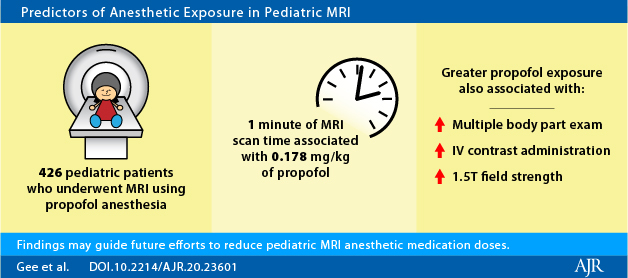
Results: A total of 501 examinations performed in 426 unique patients (172 girls, 254 boys; mean age 6.55 ± 4.59 years) were included. Single body part examinations were shorter (mean 52.7 ± 18.4 min) and received less propofol (mean 17.7 ± 5.7 mg/kg) than multiple body part examinations (mean 89.3 ± 26.4 min, and mean 26.1 ± 7.7 mg/kg) (all P < 0.001). Among single body part examinations, a higher ASA classification, oncologic diagnosis, 1.5T magnet, and IV contrast administration were associated with longer MRI scan times (all P ≤ 0.009) and higher propofol exposure (all P ≤ 0.005). In multivariable analysis, greater propofol exposure was predicted by MRI scan time (0.178 mg/kg per minute of exam 95%CI 0.155 – 0.200, P < 0.001), multiple body part examination (p=0.036), and IV contrast administration (p=0.048); lower exposure was predicted by 3T magnet (p=0.035).
Conclusion: Pediatric MRI anesthetic exposure can be quantified and predicted based on imaging and clinical variables.
Clinical Impact: This study serves as a valuable baseline for future efforts to reduce pediatric MRI anesthetic medication doses and MRI scan times.
Read More: https://www.ajronline.org/doi/abs/10.2214/AJR.20.23601
 pedzzzz.com
Leave a comment